
This article is currently available in English.
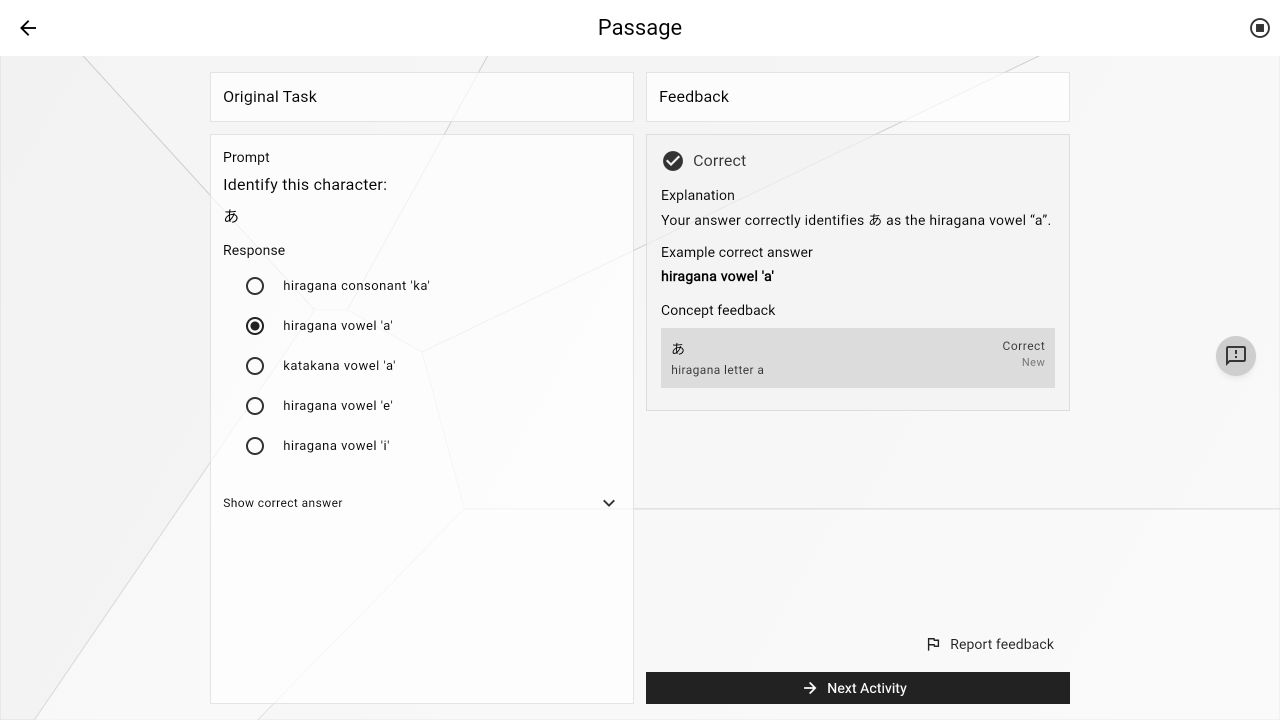
A wrong answer is not a lesson plan.
It may point to a missing word, an uncertain pattern, a reading problem, or an exercise that asked for too much too soon. Treating all of those as one generic “incorrect” event makes the next activity little better than a guess.
Shaded is designed around a more useful loop: attempt → signal → next step.
1. Start with the attempt
The learner does something that requires language: translates a sentence, fills a gap, identifies a word, listens, speaks, or works through a scenario.
The full attempt matters. The answer, the prompt, the skills being practiced, the learner’s recent history, and signals such as “too hard” provide context that a bare score cannot.
2. Resolve the learning signal
Shaded tries to identify the smallest useful piece beneath the result. Depending on the activity, that can be a word, a form, a sentence pattern, a reading, or a broader skill.
This does not mean every answer produces a perfect diagnosis. When the evidence is uncertain, the system should stay appropriately cautious. But representing the underlying pieces separately gives later practice something more precise to work with than a single pass-or-fail mark.
3. Change what comes next
The next step can keep the same learning target while changing the support around it. A free-response prompt might return with answer choices. A difficult item might gain a hint. A recently missed form might reappear in a different sentence after some space.
The goal is not to repeat the identical question until it is memorized. It is to preserve the useful focus while changing the conditions enough to help the learner use it again.
One model across different surfaces
Shaded has several ways to practice because language learning has several kinds of work. Flow can guide a session. Passage can put language in context. Concept review can focus tightly. Goals and Voyage can make momentum visible.
Those surfaces should not behave like separate products with separate memories. The learner model is the connective tissue: what was attempted, what is due, what needs support, and what has become more reliable.
That loop is still being refined. We’ll keep sharing the places where it becomes sharper—and the places where product behavior teaches us that the model needs another pass.